RAG
What is Durable RAG ingestion?
Indexing a document corpus for retrieval-augmented generation (RAG) means downloading, parsing, chunking, and embedding potentially thousands of documents, then writing the result into a vector index — a process that can run for hours and is exposed to every failure a long-running job faces: the embedding provider throttles you, a network call times out, the worker process is OOM-killed or the pod is rescheduled mid-run.
The Dapr Python SDK’s dapr.ext.rag extension solves this with DurableRAGPipeline: a document
ingestion pipeline built entirely on Dapr Workflow. Two guarantees
come from that foundation:
- A crash resumes, it doesn’t restart. Workflow durably checkpoints progress at each activity, so a worker crash resumes from the last completed document batch instead of the beginning — nothing already embedded is re-processed, and nothing is lost.
- A query never sees a half-built index. Every ingestion run builds a separate, inactive index version. Only once that version validates as complete does it switch to active — so in-flight writes are never visible to a query reading the current index.
How it works
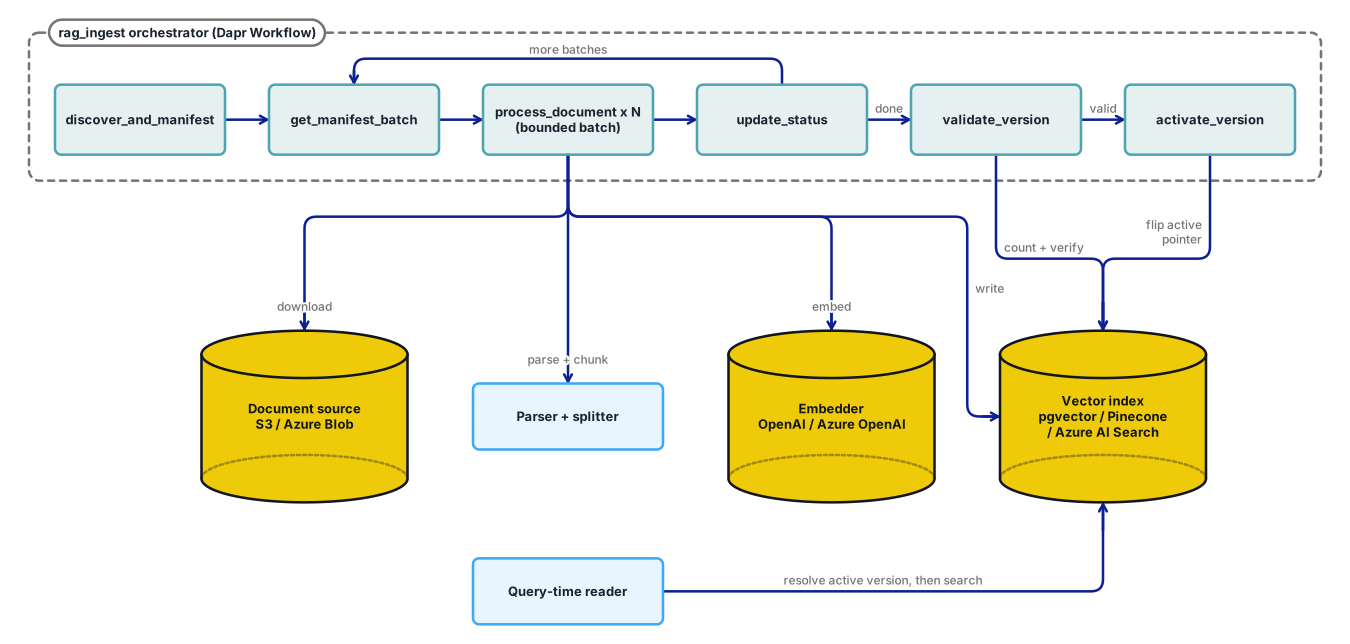
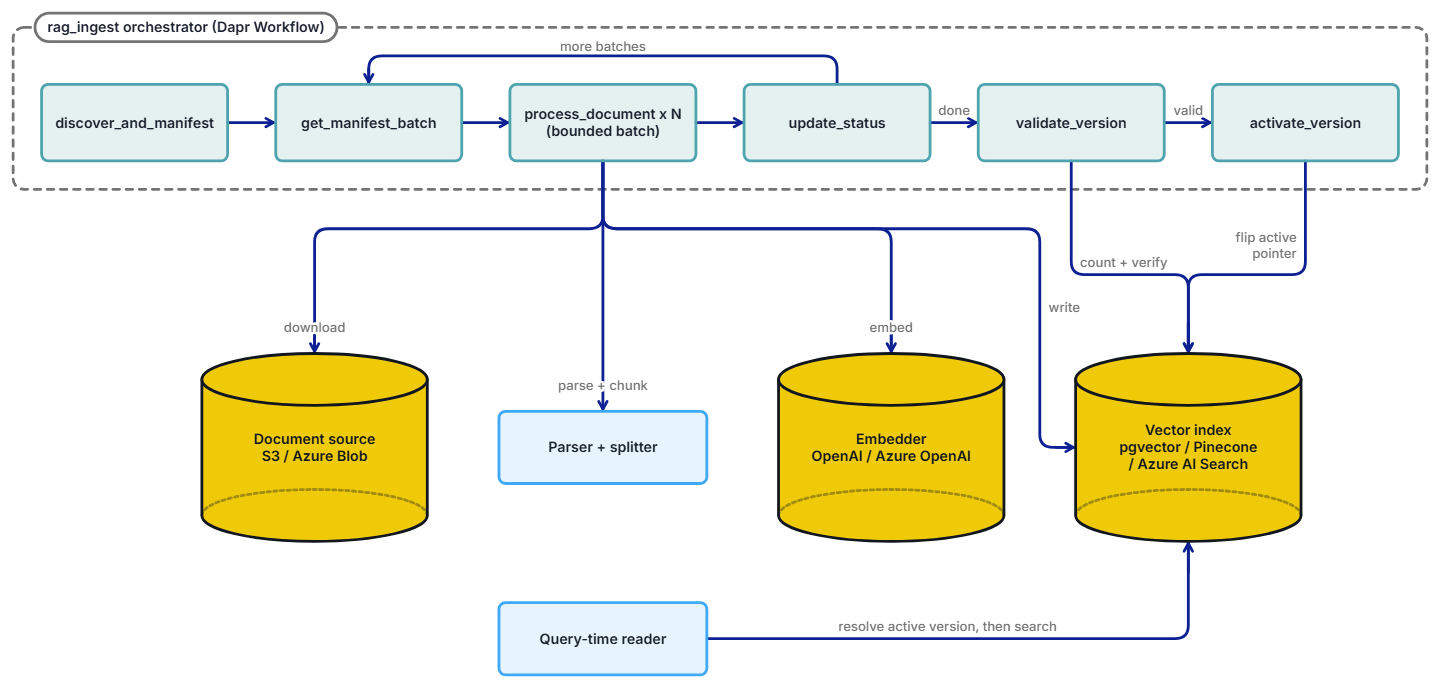
Every step that touches the network or the filesystem — listing a bucket, downloading a document, calling an embedding API, writing a vector — runs inside a Dapr Workflow activity, never in the orchestrator itself. That’s what makes the whole run replay-safe and resumable after a crash, exactly like any other Dapr Workflow.
Supported providers
Any source pairs with any embedder and any vector store:
| Concern | Options |
|---|---|
| Document source | Amazon S3, Azure Blob Storage |
| Parser | Text, Markdown, PDF, HTML, DOCX (via unstructured) |
| Embedder | OpenAI, Azure OpenAI |
| Vector store | PostgreSQL + pgvector, Pinecone, Azure AI Search |
Ingestion can also be triggered automatically as documents change — an S3 or Azure Blob event flows through Dapr pub/sub into a debounced reconciliation run, rather than requiring a manual re-ingestion call every time a document is added or updated.
Get started
- Quickstart — run a complete ingest-and-query cycle locally in a few minutes, using LocalStack for S3 and a local Postgres for pgvector.
- Python SDK docs — the rest of the Python SDK,
including Dapr Workflow, which
dapr.ext.ragis built on.
Installation
dapr.ext.rag ships inside the main dapr package as a set of optional extras — one for the
embedder/core pipeline, and one per source and vector store, so installing it never pulls in a
cloud SDK or database driver you don’t need:
pip install "dapr[rag,rag-s3,rag-pgvector]"
Swap in rag-azure (Azure Blob), rag-pinecone (Pinecone), or rag-azure-search (Azure AI
Search) for the combination you need. See the quickstart for a
full working example.
Starting, checking, and querying a pipeline
from dapr.ext.rag import (
    ActiveVersionResolver, DurableRAGPipeline, OpenAIEmbedder, PgVectorStore, S3Source,
    TextSplitter, UnstructuredParser,
)

pipeline = DurableRAGPipeline(
    source=S3Source(bucket="company-docs", prefix="policies/"),
    parser=UnstructuredParser(),
    splitter=TextSplitter(chunk_size=1000, chunk_overlap=150),
    embedder=OpenAIEmbedder(model="text-embedding-3-small"),
    vector_store=PgVectorStore(connection_string="postgresql://...", collection="company_knowledge"),
    state_store_name="rag-pipeline-state",
)
pipeline.run_worker()  # only in the process that should execute the workflow

instance_id = pipeline.start(version="2026-09", activate_when_complete=True)
status = pipeline.get_status("2026-09")

# Query-time (a separate, short-lived process — no source credentials needed):
resolver = ActiveVersionResolver(
    pipeline_id="company_knowledge", state_store_name="rag-pipeline-state",
    vector_store=PgVectorStore(connection_string="postgresql://...", collection="company_knowledge"),
    embedder=OpenAIEmbedder(model="text-embedding-3-small"),
)
matches = resolver.query("What is the remote work policy?", top_k=5)
resolver.query(...) always resolves the currently-active version fresh before searching it, so a
reader never risks reading from a version that’s still being built.
Event-driven ingestion
Rather than calling pipeline.start() by hand, a change notification can trigger ingestion
automatically: an S3 Event Notification or an Azure Event Grid/Service Bus event arrives over Dapr
pub/sub, gets deduplicated by event ID, and — after a short debounce window absorbs a burst of
related changes — starts a single reconciliation run for the affected prefix. Discovery against the
real source remains the source of truth for what actually needs indexing; the event only decides
when to check. See the
example pub/sub triggers in the Python
SDK repository for a complete, runnable subscriber for each provider.
Learn more
- Python SDK RAG examples — runnable samples for every supported source/embedder/vector-store combination, plus a crash/resume demo.
dapr.ext.ragreference docs — full configuration reference, authentication, version activation, and the Azure-native flagship path (Azure Blob → Azure OpenAI → Azure AI Search → grounded answers with citations).